
















































Gaur — iibso ama iibi


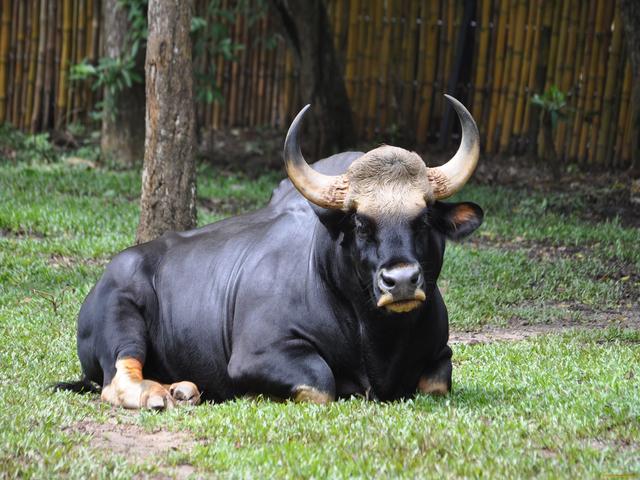
Gaur is a representative of the genus of true bulls, one of the largest bulls on the planet, resembling a huge muscular, mythical bull with large sharp horns. Gaur is a muscular giant with a massive body, weighing up to 1000-1500 kg, standing 2.5 m at the shoulder and over 3 m long. The horns of the Gaur are crescent-shaped, with sharp tips, and can reach a length of 90-100 cm. The Gaur has a leather fold on its neck and slender legs painted white, as well as a large hump on its back and long mobile ears. Gaurs possess impressive features, surpassing American bison in size. Gaurs are wild bulls that inhabit the countries of Central and Southeast Asia, in the forests of India, Pakistan, Bangladesh, Vietnam, Malaysia, and China. Gaurs have a very fearsome appearance and a fierce temperament. These muscular bulls can take on a rhinoceros, bear, and even a leopard. A strong rival for the Gaur is the tiger, which can attack stealthily; young bulls become victims of red wolves that stalk and attack a solitary bull. There are not many Gaurs, about 20,000 individuals, 90% of which live in India. According to zoological studies, Gaurs are endangered. Exterior. The coat is brown with shades ranging from reddish to black, the fur is shiny and dense, but short. Bulls are usually larger than cows, with males weighing up to 1000-1500 kg, standing 2.5 m at the shoulder, and measuring 3 m in length. They have a leather fold on the neck, a large hump on the back, a flat and wide forehead, and horns averaging 90-100 cm in length, twisted in a crescent shape. The body of the Gaur is very large, stocky, muscular, with each muscle having clear outlines; the legs are long and slender, painted white. Gaurs have a terrifying appearance, a very fierce temperament, and move quickly. From November to April, during the mating season, bulls become very aggressive, perceiving any movement as a threat and starting to attack and butt. Gaurs can get their horns tangled; usually, one horn of a bull is broken, a result of fights between males. Conditions of keeping. Gaurs are wild bulls that inhabit the countries of Central and Southeast Asia, in the forests of India, Pakistan, Bangladesh, Vietnam, Malaysia, and China. Gaurs love evergreen forests and venture into high-altitude jungles up to 3 km. They live in small herds of 10-15 individuals, with calves under the protection of the entire herd, led by the most experienced female, who chooses the location for feeding.
Gal si aad wax badan u ogaato
Soo galMaxaa lagu quudiyaa
Diet. Gaur inhabit evergreen forests and move to high-altitude jungles at elevations of up to 3,000 m. Gaurs graze near water bodies, and their diet primarily consists of fresh grass, leaves, young bamboo shoots, and shrub sprouts. Gaurs never stray far from water sources, as they require drinking and bathing, and like all bulls, they enjoy mud. Gaurs do not take mud baths; they eat mud because it contains salts and minerals. Gaurs typically graze early in the morning and in the evening. Gaurs have a weak immune system and often fall ill.
Sifooyinka jireed
Miisaanka labka: 1100–1500 kg
Miisaanka dheddigga: 900–1200 kg
Dhererka labka: 170–250 cm
Dhererka dheddigga: 160–200 cm
Deegaanka uu ku nool yahay
Bakistaan
Bangaladhesh
Fiyetnaam
Hindiya
Malaysiya
Shiinaha
Su'aalaha inta badan la isweydiiyo
Intee ayuu miisaamaa Gaur?
Xayawaan qaangaar ah: lab — 1100–1500 kg, dhedig — 900–1200 kg.
Waa imisa dhererka Gaur?
Dhererka garbaha: lab — 170–250 cm, dhedig — 160–200 cm.
Xaggee ayuu ka soo jeedaa Gaur?
Waddanka asalka ah — Hindiya.
Halkee lagu dhaqaa Gaur?
Noocan waxaa laga helaa: Bakistaan, Bangaladhesh, Fiyetnaam, Hindiya, Malaysiya, Shiinaha.
Maxaa lagu quudiyaa Gaur?
Diet.
Su'aal iyo jawaab
Weli su'aalo ma jiraan. Weydii kan ugu horreeya!
Soo gal si aad su'aal u weydiiso