












Guernsey — iibso ama iibi


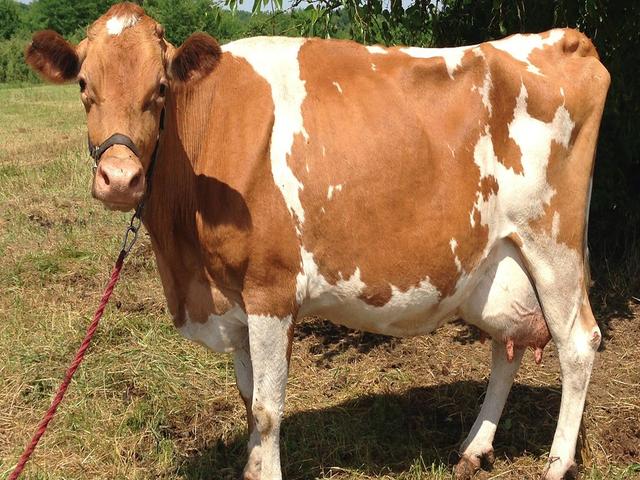
History of the breed: The Guernsey cow is a dairy breed known for its rich, aromatic milk with a characteristic golden-yellow hue. This breed is distinguished by its endurance, docile temperament, and ability to adapt to various climatic conditions. The Guernsey breed originated on the picturesque island of Guernsey, nestled in the waters of the English Channel. The history of this breed is shrouded in mystery, as the earliest mentions of it in documents date back only to the 19th century, and its exact origin remains a puzzle. There is a hypothesis that the ancestors of Guernsey cows were cattle brought to the island from France. They may have been tiger-striped representatives of the Norman breed or wheat-colored, resembling the Froman du Leon breed from Brittany. The influence of Dutch cattle, which may have arrived on the island in the 18th century, is also possible. In the Middle Ages, cattle played an important role in the life of the island, performing heavy work in the fields. In the 18th century, active exports began from the Channel Islands to England, including cattle previously brought from France. In an effort to preserve the purity of the breed, the importation of French cattle was banned in Guernsey in 1819. However, the import of British cattle continued until 1877. During World War II, cattle from the neighboring island of Alderney were evacuated to Guernsey, and some of these animals were crossed with Guernsey cows. In the early 20th century, the export of Guernsey cattle and semen became an important source of income for the island. A large number of cows were sent to the USA and Commonwealth countries. Today, the Guernsey breed is popular in the UK, USA, Australia, Canada, New Zealand, and South Africa. However, despite its fame, the Guernsey breed is currently considered rare. The American Livestock Breeds Conservancy has listed it as a watch breed, as fewer than 2,500 purebred calves are registered annually in the USA. The total population of the breed worldwide is estimated to be less than 10,000 head. Exterior: Guernsey cows are not large in size, but their appearance is full of grace and harmony. The average weight of cows is 450-500 kg, while bulls are slightly larger at 600-700 kg. The coat color of Guernsey cows can vary from delicate fawn to rich red, reminiscent of ripe wheat. There are also piebald individuals with red-and-white or fawn-and-white spots.
Gal si aad wax badan u ogaato
Soo galMaxaa lagu quudiyaa
Diet: Guernsey is a good pasture animal and is capable of producing milk on quality pastures. The nutrition of Guernsey cows is the key to their health and high productivity. Like all dairy breeds, Guernsey cows require a balanced diet that provides their bodies with energy, protein, fiber, water, minerals, and vitamins. All these components are necessary for maintaining vitality, growth, milk production, and fetal development in pregnant cows. To accurately dose nutrients in each meal, TMR (Total Mixed Ration) is often used. TMR is a specially prepared mixture that includes hay, silage, grain, protein supplements, vitamins, and minerals. Sometimes, by-products from the food industry are also added to TMR. Water is the foundation of life, and Guernsey cows need constant access to clean and fresh water. A single cow can drink up to 190 liters of water per day, especially in hot weather and during high milk production. Guernsey cows are excellent pasture animals. They are well adapted to grazing and enjoy eating grass in pastures. On their native island of Guernsey, farmers practice grazing in small fields rich in diverse vegetation. Guernsey cows are known for their efficiency in converting feed into milk. They consume 20-30% less feed than larger breeds, such as Holsteins, while producing milk with a higher fat and protein content. To maintain the health and productivity of Guernsey cows, it is important to manage their nutrition properly. It is necessary to monitor the weight of the cows, especially during early lactation, to avoid fertility issues.
Sifooyinka jireed
Miisaanka labka: 600–700 kg
Miisaanka dheddigga: 450–500 kg
Dhererka labka: 120–150 cm
Dhererka dheddigga: 115–140 cm
Deegaanka uu ku nool yahay
Awstaraaliya
Boqortooyada Midowday
Kanada
Koonfur Afrika
Maraykanka
Su'aalaha inta badan la isweydiiyo
Intee ayuu miisaamaa Guernsey?
Xayawaan qaangaar ah: lab — 600–700 kg, dhedig — 450–500 kg.
Waa imisa dhererka Guernsey?
Dhererka garbaha: lab — 120–150 cm, dhedig — 115–140 cm.
Xaggee ayuu ka soo jeedaa Guernsey?
Waddanka asalka ah — Boqortooyada Midowday.
Halkee lagu dhaqaa Guernsey?
Noocan waxaa laga helaa: Awstaraaliya, Boqortooyada Midowday, Kanada, Koonfur Afrika, Maraykanka.
Maxaa lagu quudiyaa Guernsey?
Diet: Guernsey is a good pasture animal and is capable of producing milk on quality pastures.
Su'aal iyo jawaab
Weli su'aalo ma jiraan. Weydii kan ugu horreeya!
Soo gal si aad su'aal u weydiiso