
















































Banteng — iibso ama iibi





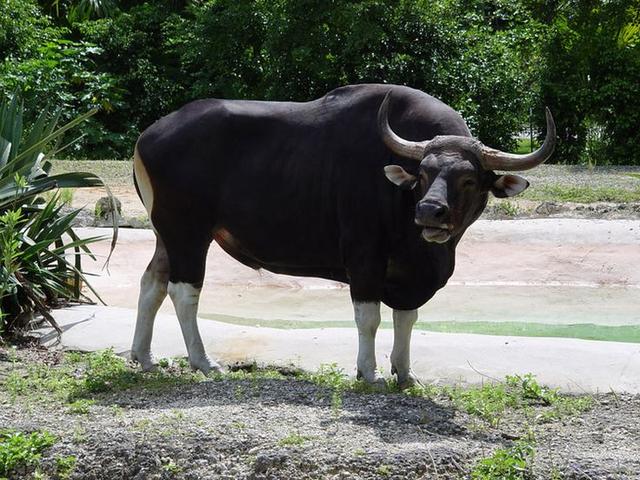
History of the breed. Banteng is a representative of the genus of true cattle, also known as Tembadau. Bantengs inhabit Southeast Asia and were domesticated by humans; they are known as Bali cattle. Bantengs were first described by the German zoologist Joseph Wilhelm Eduard d'Alton in 1823. There are three subspecies of Bantengs: the Javan Banteng, which inhabits Java and Bali; the Indochinese Banteng, which is found in the mainland part of Southeast Asia; and the Bornean Banteng, which inhabits Borneo. Banteng is a meat breed, previously used as a pack animal. Bantengs move very quickly, are well camouflaged in dense vegetation from predators, can signal danger, and have very acute hearing. Exterior. Male and female Bantengs differ in color; the coat of the adult bull is black or dark brown, while the cow's coat is pale brown, chestnut, or brown. All Banteng individuals have large white spots on their bodies. Female Bantengs have a white stripe along their backs, and the faces of Banteng individuals are light, but their muzzles are black. Bantengs externally resemble antelopes, having long slender limbs that are white in color. The thoracic vertebrae are unusually long, thus raising the back and creating the impression of a hump. Wild Bantengs are larger than domestic Bantengs; wild bulls weigh 600-700 kg, while domestic ones weigh 350-400 kg. Domestic male Bantengs are larger than females, with bulls reaching a shoulder height of 1.5 m and cows 1.2 m. The weight of cows is 250-300 kg, and bulls 350-400 kg. Bantengs have large horns, which can reach sizes of 65-70 cm. The horns of cows are strongly curved and short, while those of bulls are thin, long, and pointed. Conditions of keeping. Bantengs usually live in herds of up to 40 females with calves and one bull, but there are separate groups of young males and old males. Bantengs prefer to graze in evergreen forests, bamboo thickets, and clearings. Bantengs are very well camouflaged in forests, can hide in dense vegetation, and remain unnoticed. They can be active both day and night, but they prefer a diurnal lifestyle; during the rainy season, Bantengs move high into the mountains. They have a calm temperament and can unite in large groups of up to 100 heads. Bantengs are undemanding in terms of food, feeding on bamboo, leaves, branches, and grass. During drought periods, they can go for a long time without water. Purpose. Bantengs are a meat breed, and their meat is valued for its taste qualities; it is lean, containing only 4% fat, and is tender.
Gal si aad wax badan u ogaato
Soo galMaxaa lagu quudiyaa
Diet. Bantengs are herbivorous animals that feed on vegetation, grass, bamboo, leaves, shoots, flowers, and also graze in meadows and glades. Bantengs can gain weight well on poor feed and can go for a long time without water during drought periods; they can drink seawater. In Australia, bantengs consume algae. During the rainy season, bantengs move to elevated areas, to mountain forests in search of food, and can use tree bark and shrub branches as feed.
Sifooyinka jireed
Miisaanka labka: 350–700 kg
Miisaanka dheddigga: 250–400 kg
Deegaanka uu ku nool yahay
Awstaraaliya
Fiyetnaam
Indoneesiya
Kamboodiya
Laos
Malaysiya
Taylaand
Su'aalaha inta badan la isweydiiyo
Intee ayuu miisaamaa Banteng?
Xayawaan qaangaar ah: lab — 350–700 kg, dhedig — 250–400 kg.
Xaggee ayuu ka soo jeedaa Banteng?
Waddanka asalka ah — Indoneesiya.
Halkee lagu dhaqaa Banteng?
Noocan waxaa laga helaa: Awstaraaliya, Fiyetnaam, Indoneesiya, Kamboodiya, Laos, Malaysiya, Taylaand.
Maxaa lagu quudiyaa Banteng?
Diet.
Su'aal iyo jawaab
Weli su'aalo ma jiraan. Weydii kan ugu horreeya!
Soo gal si aad su'aal u weydiiso