
















































Vechur — beli atau jual


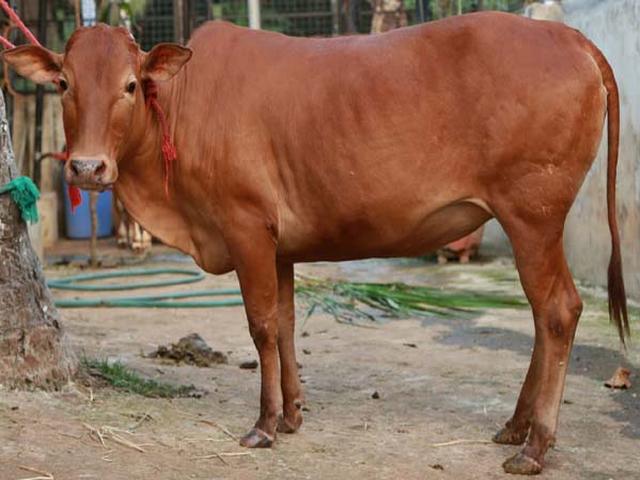
Breed history: Vechur is an amazing breed of dwarf cows from India, which is considered the smallest cow in the world according to the Guinness World Records. These cows attract the attention of scientists and farmers with their miniature size and good milk productivity. In the southern part of India, in the state of Kerala, there is a small village named Vechur. The name of this small cow comes from this village. Miniature breeds of cows, like the Vechur, were quite common throughout the country, with more than twenty-five identified. However, in the last century, the Indian government decided to increase milk production. To achieve this goal, small breeds of cows were crossed with larger ones. As a result of these actions, the Vechur breed was on the brink of complete extinction. But in 1989, Professor Sosamma Ayp, an expert in animal husbandry and genetics, along with her students, started a program to save the Vechur breed. They traveled all over India, collecting representatives of this breed, and managed to find about thirty cows and one purebred bull. Thanks to modern scientific methods, researchers were able to restore the population of Vechur cows. Shortly thereafter, in 1998, a special fund was created for the preservation of the breed, which also involved the farmers themselves. Currently, the number of Vechur cows is estimated to be around three thousand heads. Although some researchers cite lower figures, around two hundred heads, of which about one hundred are under observation at a veterinary college. Despite the increase in the number of Vechur cows, this breed is still considered rare and is at risk of extinction. Exterior: Vechur cows are so small that they can be called miniature. Their height at the withers is about 87 centimeters. They weigh approximately 130 kg, although sometimes smaller individuals are found, weighing around 100 kg. Vechur bulls are slightly larger than the cows. The color of these cows can vary widely: from light red to black, as well as fawn with white spots. The front part of the body of bulls is usually darker than the back, sometimes even dark gray. The head of Vechur cows is small, with a short and slightly convex forehead, and a wide muzzle. Their horns are small and thin, curved forward and downward. Sometimes the horns are so small that they are almost invisible.
Log masuk untuk mengetahui lebih lanjut
Log masukApa yang perlu diberi makan
Diet: The Vechur breed of cow is distinguished by its hardiness regarding feed and does not require a large amount of food for its normal existence. These small animals do not need grain supplements, which makes their care simpler and more cost-effective. For grazing a Vechur cow, only a small space is sufficient, just a quarter of an acre per cow. These cows will happily eat a variety of vegetation, including fibrous and tough plants that may seem difficult for other larger breeds to digest. Cows typically eat grass, so it, like in many other breeds, is the base of their diet. Vechur cows are also not averse to consuming banana peels and other plant-based leftovers that usually remain after cooking. This allows them to obtain a variety of beneficial substances from different sources, making their diet richer and more diverse. Despite their compact size and general hardiness, Vechur cows still require a balanced diet to maintain their health and productivity. One thing is clear: grain supplements are not essential for their diet, and these cows can thrive on grasses, diverse vegetation, and plant-based food waste.
Parameter fizikal
Berat jantan: 120–140 kg
Berat betina: 100–130 kg
Tinggi jantan: 75–87 cm
Tinggi betina: 70–80 cm
Habitat
India
Soalan lazim
Berapakah berat Vechur?
Haiwan dewasa: jantan — 120–140 kg, betina — 100–130 kg.
Berapakah ketinggian Vechur?
Ketinggian pada paras layu: jantan — 75–87 cm, betina — 70–80 cm.
Dari mana berasal Vechur?
Negara asal — India.
Apa yang perlu diberi makan kepada Vechur?
Diet: The Vechur breed of cow is distinguished by its hardiness regarding feed and does not require a large amount of food for its normal existence.
Soal jawab
Belum ada soalan. Ajukan soalan pertama!
Log masuk untuk bertanya